
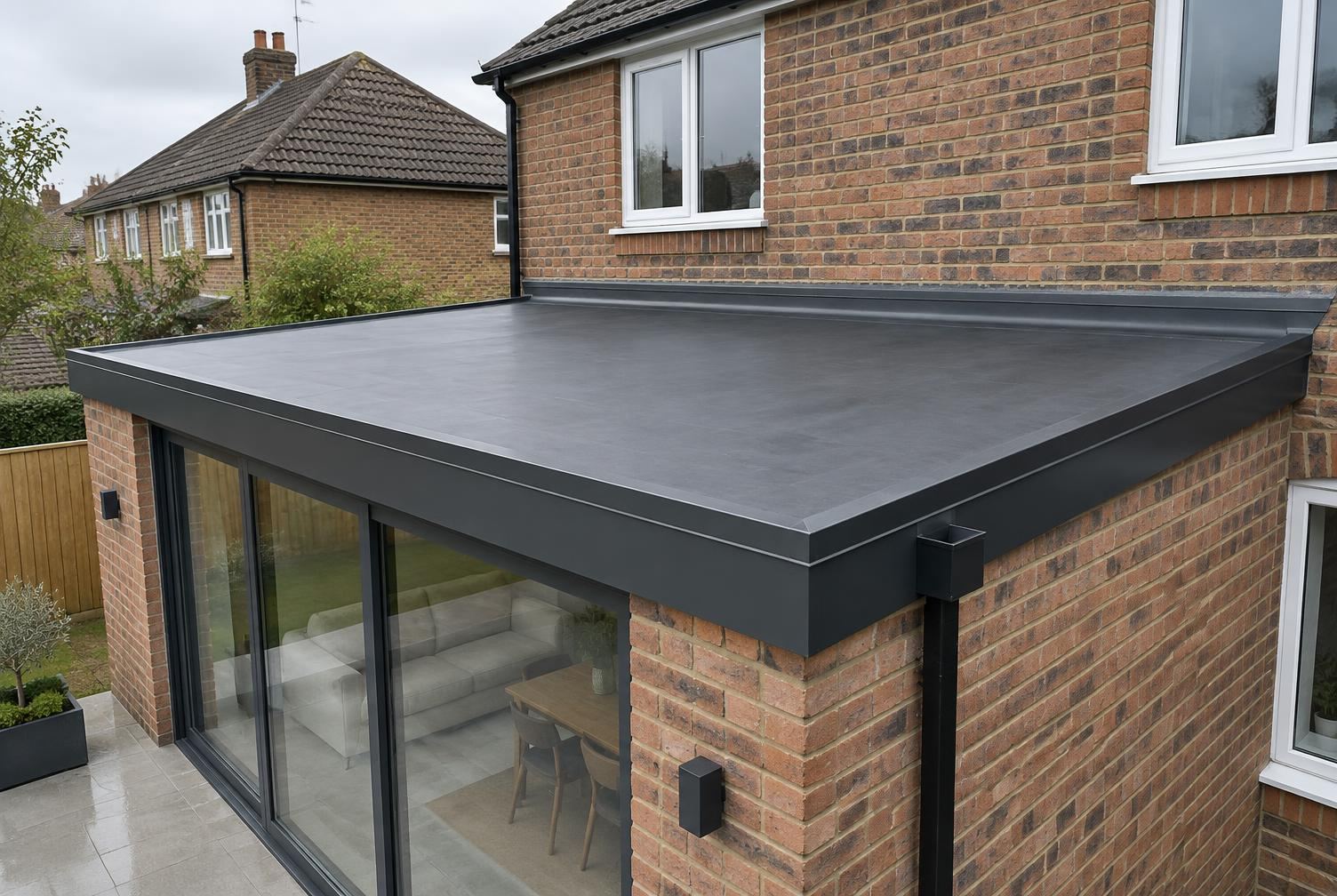
Flat roofing
Torch-on felt roofing
Torch-on felt is built up in layers of reinforced bitumen membrane, each one melted onto the layer below, with a mineral-finished top sheet that takes the weather. It's tough and straightforward to patch, but it goes down with an open flame, so we decide where the torch can and can't go before the job starts.
Layered, heat-bonded felt roofs for extensions, garages, dormers and roofs you need to walk on.
Free photographed survey
Every slope, chimney and gutter photographed.
Report yours to keep
Whether you hire us or not.
Agreed in writing
Scope fixed before any work starts.
One point of contact
Your survey and every follow-up handled by one person, Mon–Sat, 8am–6pm.
The material
What is torch-on felt?
Modern torch-on is reinforced bitumen membrane: bitumen modified with a polymer, usually SBS, and reinforced with polyester.
The polymer keeps the bitumen flexible. IKO says the top layer, called the cap sheet, is surfaced with mineral granules in colours such as green, black and brown.
It isn't the same as older felt roofs laid in poured hot bitumen with loose stone chippings on top, though it can be laid over or alongside them.
The layers
How a torch-on roof is built up
From the deck upwards, each layer has its own job.
- 1.The deck, checked first and replaced wherever it's soft or old.
- 2.A vapour control layer and insulation, where the roof is insulated above the deck.
- 3.A first layer, which on a timber deck is often a perforated venting layer nailed down (Roofing Superstore's guide).
- 4.An underlay, torched onto that first layer.
- 5.The cap sheet, torched on top, with its laps staggered so no two joins line up.
Around the edges, the felt turns at least 150mm up each wall, drip trims carry water into the gutter, and every outlet is dressed in.
Fire safety
How we keep torching safe
We follow Safe2Torch, so fire risks are found at the survey and those spots get torch-free products from the start.
Safe2Torch is the National Federation of Roofing Contractors' campaign, launched in July 2017 to cut roof fires caused by gas torches. Its guidance says the parts of a specification with a fire risk should default to torch-free products, switching back to the torch only where the area is shown to be safe.
On a house, those risky spots are usually timber fascias and cladding, eaves and gaps into the roof void, rooflight kerbs, and timber garden buildings.
Suitability
Where torch-on works best
It earns its place on roofs that get walked on, roofs that meet other felt, and roofs you look down on.
- Roofs walked on for maintenance or to reach plant.
- Joining onto an existing felt roof on a neighbouring garage or extension, since bitumen bonds to bitumen.
- Roofs overlooked from upstairs windows, where a coloured mineral finish looks better than black rubber.
It's less suited to a roof right against timber cladding, or to a timber garden room, unless torch-free products are used in those places.
Weather
When can torch-on be laid?
On any dry day, including in winter, as long as there's no frost on the surface.
The laps won't bond to a wet or frosty deck. Cold makes the rolls stiffer to handle, but that slows the work rather than stopping it.
Fire
Fire rating close to a boundary
Within 6m of a boundary the roof has to reach BROOF(t4), and that rating is earned by a whole system rather than one sheet.
Because the certificate describes a complete build-up, we lay exactly what it lists, from the deck up to the cap sheet.
Care
Looking after a torch-on roof
Keep the water moving and the mineral finish intact, and a felt roof will look after itself.
- Clear outlets and gutters after leaf fall. Our gutter cleaning takes in flat roof outlets.
- Look for bald patches where the granules have washed off, because bare bitumen ages faster in the sun.
- Check where the felt meets the wall.
- Don't drag anything across the cap sheet.
- Get blisters and splits looked at early. See felt and torch-on roof repairs.
Comparison
Torch-on or EPDM?
Torch-on is the harder-wearing choice for a roof that gets foot traffic or meets another felt roof.
Rubber needs no flame and often covers a simple roof in a single piece. Where timber is close by or the shape is plain, read about EPDM rubber roofing instead.
Cost
What affects the cost of a torch-on roof?
The number of layers, the state of the deck and any torch-free work near timber make the biggest difference.
- How many layers the roof needs.
- Insulation.
- The deck.
- Torch-free details next to timber.
- Upstands, pipes and rooflights.
- Access.
- Stripping old felt and chippings.
Questions
Torch-on felt questions
Is torch-on felt the same as old roofing felt?
No. It's polymer-modified and polyester-reinforced, laid in layers by heat, rather than the older felts bedded in hot poured bitumen and finished with chippings.
Can torch-on go on a shed or garden room?
Timber buildings are exactly where Safe2Torch says the specification should default to torch-free products, rather than an open flame.
Can torch-on go over my existing felt roof?
IKO says its TGX cap sheet can overlay existing bitumen or asphalt roofing. We'd only do that if the old roof is sound, dry and well stuck down.
On overlaying: Repair, overlay or replace? on our flat roofing page.
Related
Felt and torch-on roof repairs
Blisters, splits, bald patches and lifted laps on felt roofs repaired.
EPDM rubber roofing
Flame-free rubber sheet for simple roof shapes.
Flat roofing
Choosing between the flat roof systems for a new roof.
Flat roof repairs
Leaks and ponding on any flat roof traced and put right.
Chimney work and leadwork
Lead flashings where roofs meet walls and stacks.
Sources and further reading
- Safe2Torch campaign (NFRC)
- What is Safe2Torch guidance? (IKO)
- NFRC launches Safe2Torch guidance (Specification Online, July 2017)
- TGX torch-on SBS cap sheet (IKO)
- Fire regulations guidance for flat roofs (LRWA, NFRC and SPRA)
- BS 6229:2025, the key changes (Bauder)
Written by Hawkes Roofing, roofers based in St Albans. Last reviewed .
Free · Photographed · No pressure
Find out what your roof actually needs.
Get a quote for your roofing work. The survey is free. If we can advise from your photos, we’ll tell you; if we need to look, we photograph every part we can safely reach.