
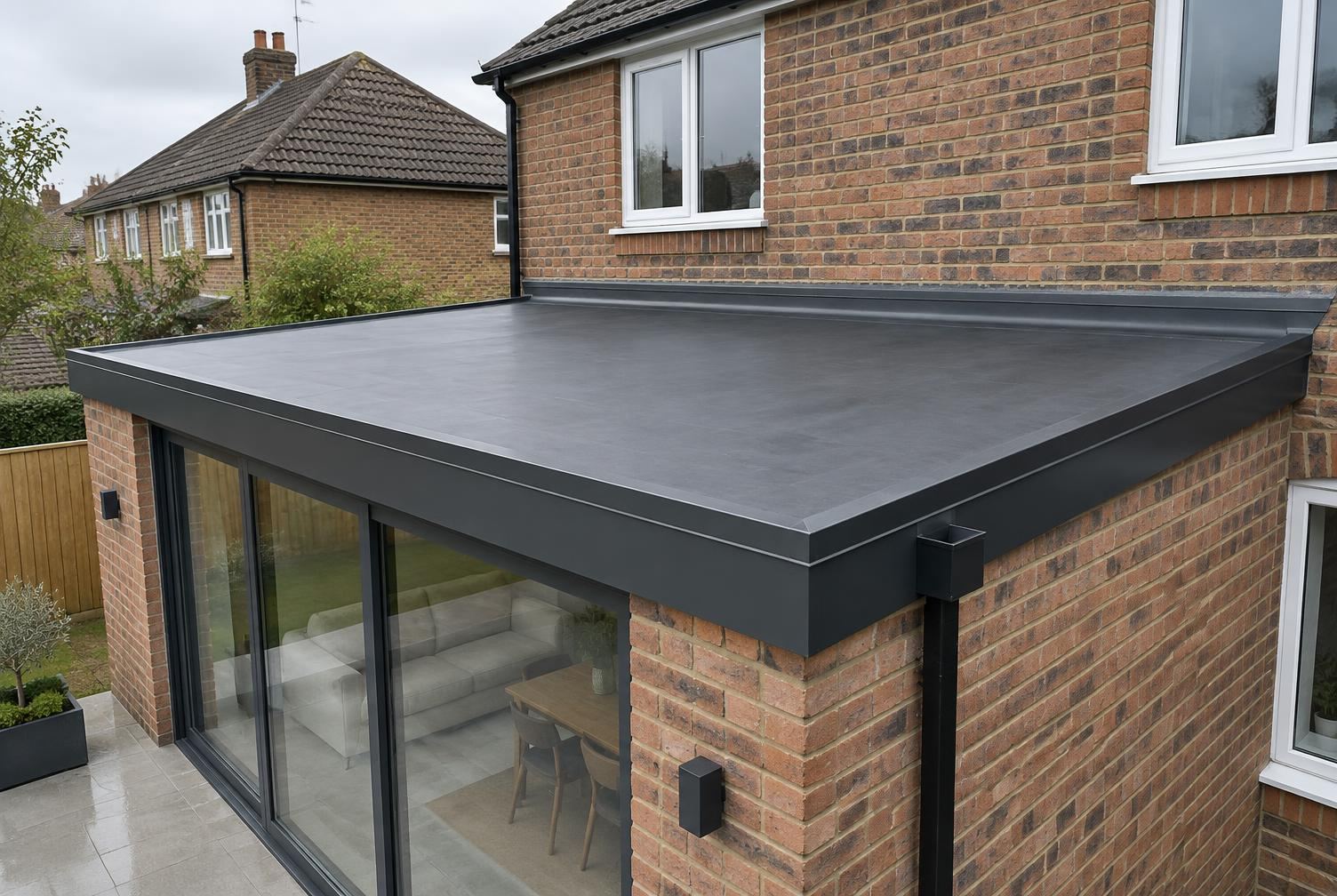
Roofing service
Flat roof repairs
Most flat roof leaks start at an edge, such as an upstand, trim, outlet or flashing, rather than in the middle of the roof. We find where the water is getting in before we fix anything, and show you photos of the cause.
Leaks, splits, blisters and ponding traced and fixed on EPDM rubber, felt and GRP flat roofs.
Free photographed survey
Every slope, chimney and gutter photographed.
Report yours to keep
Whether you hire us or not.
Agreed in writing
Scope fixed before any work starts.
One point of contact
Your survey and every follow-up handled by one person, Mon–Sat, 8am–6pm.
Signs
Signs your flat roof needs repairing
Water indoors is the obvious one, but standing water, blisters, splits and loose edges all come first.
Water coming through the ceiling
Drips or a wet patch indoors after rain mean water has already found a way through the covering and the deck.
A stain away from the fault
Water runs across the deck under the membrane before it finds a way down, so the mark on the ceiling can be some distance from where it gets in.
Water still standing a day after rain
Either the fall is wrong or an outlet is blocked, and the standing water keeps working at every lap and seam.
Blisters or bubbles
Raised pockets in the surface show where the covering has lost its bond with the layer below.
Splits and cracks
These often run along board joints, or appear where the roof meets a wall.
Bald patches on mineral felt
Where the granules have gone, the bare bitumen underneath is left exposed to sunlight.
Lifting trims or edges
A loose edge trim lets wind-driven rain get under the covering at the perimeter.
Damp or mould in cold, dry weather
If it appears with no rain, it's often condensation rather than a leak. The section on condensation below explains why.
Tracing
How we find a flat roof leak
We check the edges and details outside first, then look underneath, and photograph every likely cause.
Outside, we work in order: upstands and flashings, trims, outlets and gutters, rooflight kerbs, pipes and flues, and then the open roof for splits, blisters and open laps.
Inside, we look at the ceiling below and at the deck from underneath wherever we can reach it. Each likely cause goes into your report with a photo.
The decision
Repair or replace? How we decide
A fault in one place is usually a repair; the same fault across the whole roof, or a wet deck, points to replacement.
| Fault | Usually a repair | Points to replacement |
|---|---|---|
| Split, tear or puncture | Patch with matching material | Splits across much of the roof |
| Upstand or flashing failed | Re-form the upstand and re-flash | Every upstand failing at once |
| Blister | Leave it if it's intact and dry; cut out, dry, re-bond and patch if it's split | Blistering over large areas |
| Water standing after rain | Clear the outlet; correct a small dip | The whole roof falls the wrong way |
| Outlet or gutter blocked | Clear it and fit a leaf guard | Rarely |
| Soft deck | A small area can sometimes be cut out and replaced | Soft in more than one place |
| Wet insulation | Not as a repair | Insulation wet across the roof |
Chipboard and strawboard decks, common on older flat roofs, have most likely outlived their structural life according to IKO. A soft spot in one of those usually means a new deck.
Roof types
Repairs by roof type
Every repair uses materials that match the roof, because mixing systems causes new failures.
Felt and torch-on
Patches are bonded with matching membrane, using torch-free products where a flame isn't safe.
Felt and torch-on roof repairsCondensation
Is it a leak or condensation?
If the drips come in cold weather with no rain, condensation under the deck is the more likely cause.
A cold flat roof has its insulation between the joists, with a ventilated gap above. If that gap is too small or blocked, warm, moist air from the room condenses under the deck and drips like a leak.
LABC's guidance for cold flat roofs is at least a 50mm ventilation gap above the insulation, continuous 25mm gaps along two opposite eaves, and a vapour barrier on the warm side of the insulation. The lasting fix is usually converting it to a warm roof when the roof is next replaced; our flat roofing page covers replacement.
Emergencies
Emergency flat roof leaks
If water is coming in now, call 07404 216065.
We make the roof safe first and come back for the proper repair in dry weather. Our emergency roof repairs page has steps to take while you wait.
Regulations
Do flat roof repairs need Building Regulations approval?
Patch repairs don't.
Replacing the waterproofing over more than half the roof counts as renovation, which brings in insulation requirements and building control. The Building Regulations box on our flat roofing page explains what applies.
Timing
When to book a flat roof repair
Book a leak straight away; plan other repairs for a dry spell.
- A leak: straight away.
- Other repairs: a dry spell, because adhesives, tapes and torch-on membranes all need a dry surface.
- Autumn: after the leaves are down, when blocked outlets cause the most standing water.
Cost
What affects the cost of a flat roof repair?
Mostly the time it takes to find the leak and how much of the edge detail needs redoing.
- How long it takes to trace the leak.
- The roof type.
- Access and height.
- How much of the edge detailing needs re-forming.
- Whether the deck is wet underneath.
- Torch-free products next to timber.
Questions
Flat roof repair questions
Can you repair a flat roof rather than replace it?
Often, if the deck is dry and sound and the fault is in one place. If the deck is saturated, replacement is the only lasting fix.
Can a flat roof be repaired in the rain?
We can make it safe in the rain, but a permanent repair needs a dry surface, so we come back when it's dry.
Why does my flat roof only leak in heavy rain?
Usually because water is building up somewhere: a blocked outlet backing water over the top of an upstand, a dip deep enough to reach an open lap, or wind driving rain under a trim.
Will my home insurance pay for a flat roof repair?
It depends on your policy. Insurers often cover sudden storm damage but not wear and tear. Tell your insurer promptly, and keep our photos and report for the claim.
Related
EPDM rubber roof repairs
Rubber roofs repaired with compatible rubber products.
Felt and torch-on roof repairs
Felt roofs patched with matching membrane.
Flat roofing
New and replacement flat roofs when a repair won't last.
Roof leak repairs
Leaks on pitched roofs traced to their source.
Emergency roof repairs
Making a roof safe when water is coming in now.
Gutter cleaning
Gutters and outlets cleared before they back up.
Sources and further reading
- How to avoid defects claims on flat roofs (LABC)
- Assessing a roof for refurbishment (Bauder)
- Can you overlay an existing flat roof? (IKO)
- BS 6229:2025, the key changes (Bauder)
Written by Hawkes Roofing, roofers based in St Albans. Last reviewed .
Free · Photographed · No pressure
Find out what your roof actually needs.
Get a quote for your roofing work. The survey is free. If we can advise from your photos, we’ll tell you; if we need to look, we photograph every part we can safely reach.