
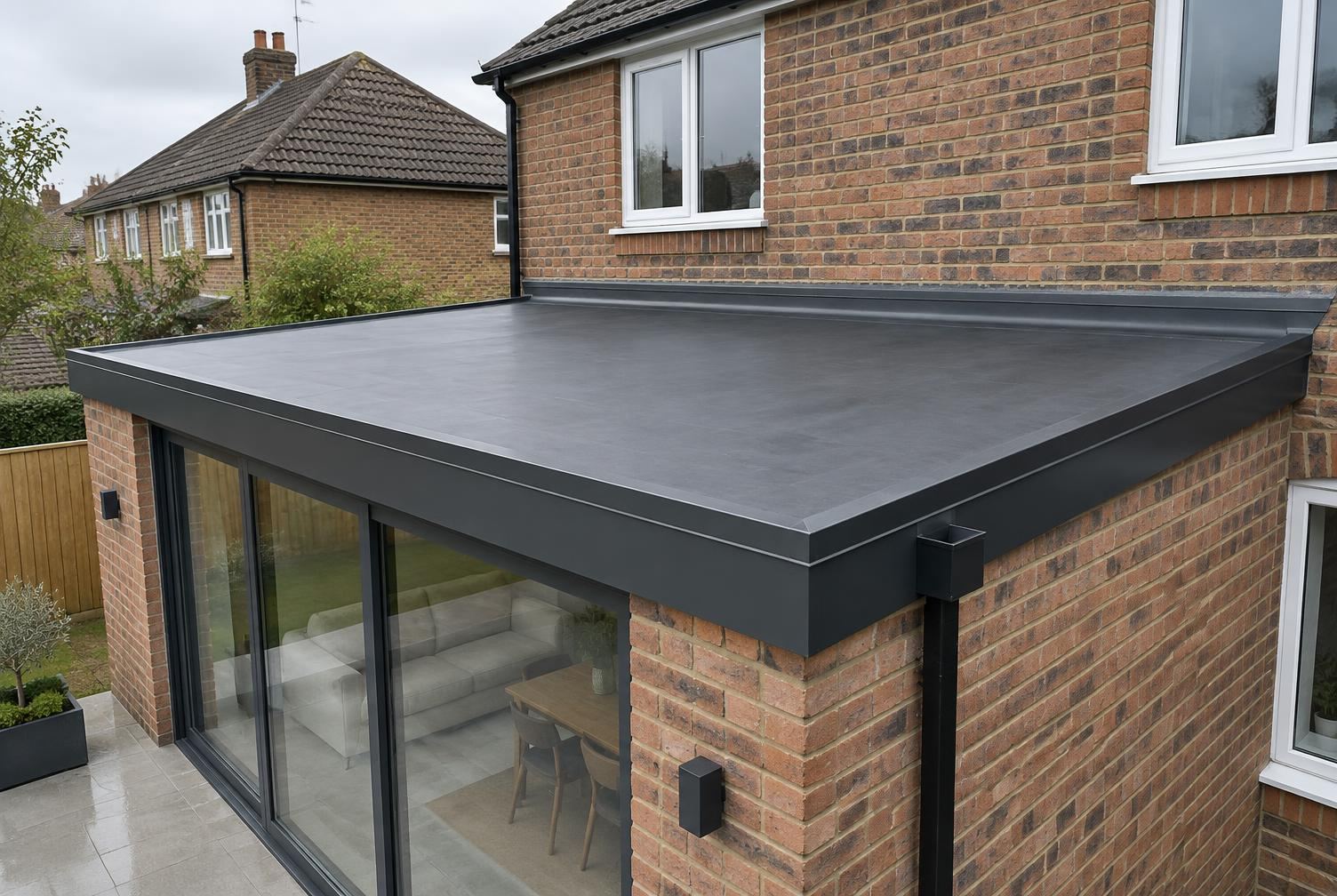
Flat roofing
EPDM rubber roofing
EPDM is a synthetic rubber membrane that usually goes down as one sheet on a garage or extension roof, so there are no joins across the roof for water to find. We bond it to a sound deck with a proper fall, and take most care over the edges, where rubber roofs usually fail.
One-piece rubber flat roofs for garages, extensions, dormers and porches.
Free photographed survey
Every slope, chimney and gutter photographed.
Report yours to keep
Whether you hire us or not.
Agreed in writing
Scope fixed before any work starts.
One point of contact
Your survey and every follow-up handled by one person, Mon–Sat, 8am–6pm.
The material
What is EPDM?
EPDM stands for ethylene propylene diene monomer, a synthetic rubber.
Roofing EPDM arrives already cured, as a flexible black sheet. Elevate says it resists UV and ozone and needs no top coat.
Elevate's RubberCover comes in rolls as wide as 9.15m. That means many garages and single-storey extensions can be covered without a single join.
Suitability
Is EPDM right for your roof?
It suits most simple flat roofs, but a few uses call for extra protection or a different system.
Good fit
- Simple roof shapes without many corners.
- Garages, extensions, dormers and porches.
- Roofs that are walked on only for maintenance.
- Sedum roofs, with a root-resistant layer between the plants and the membrane, and planting kept 30cm back from edges and details (Elevate).
Think twice
- Roofs used as a terrace, which need pavers on a protection layer or a different system.
- Roofs with a hot flue through them, where Elevate requires a double-walled penetration.
- Anywhere oil, grease or fresh bitumen could reach the membrane.
Our method
How we fit an EPDM roof
We prepare the deck first, bond the rubber with the maker's own products, then spend most of the time on upstands, trims and outlets.
- 01
Check the deck
Soft or old boards are replaced, usually with OSB3 or plywood. The deck must be clean, dry and smooth before anything is bonded to it.
- 02
Insulation and falls
Insulation goes in where Building Regulations call for it, and the finished fall is at least 1 in 80. Our flat roofing page sets out both.
- 03
Bond the membrane
Adhesive goes on exactly as the maker specifies. Elevate's RubberCover adhesive is spread on both the deck and the membrane, at 5°C or warmer and no more than 80% humidity.
- 04
Upstands
The rubber runs at least 150mm up each wall, fully bonded, and is finished with a wall trim or flashing.
- 05
Edges and outlets
Kerb and gutter trims are fixed and sealed, and each outlet is sealed in with EPDM flashing.
- 06
Joins, where there are any
Each join is cleaned, primed and sealed with EPDM seam tape. ClassicBond's installation guide specifies a 75mm seam.
- 07
One system throughout
Membrane, adhesive, primer, tapes and trims all come from the same maker. Makers tell installers not to substitute other products.
- 08
Photos of the finished roof
We photograph the completed rubber roof, its upstands and outlets so you have a record of them.
Weather
When can EPDM be laid?
Whenever the deck is dry and the air is warm enough for the adhesive to work.
Elevate says there must be no ponding, frost or ice on the deck. The adhesives also have minimum temperatures, so a run of cold, damp days can hold a job up. Spring to autumn is easiest, and in winter we book around dry spells.
Fire
Fire rating close to a boundary
A roof less than 6m from a boundary must be classified BROOF(t4), and that often includes garages and rear extensions.
An EPDM roof earns that rating as a complete tested build-up, so the deck, insulation and adhesive matter as much as the rubber. We check the system's certificate covers exactly what we're laying.
Care
Looking after an EPDM roof
A rubber roof needs little attention, but a few habits keep it sound.
- A yearly inspection, which Elevate recommends.
- Leaves cleared from outlets and gutters each autumn. Our gutter cleaning includes flat roof outlets.
- Oil, grease, solvents and bitumen kept off it, including felt paint and bitumen mastic.
- Walking on it for maintenance only.
- Anything added later, such as a satellite dish or solar panel fixings, detailed with EPDM-compatible products.
Lifespan
How long does an EPDM roof last?
The membrane itself can last decades; the deck and edge details usually decide the real lifespan.
Elevate says recent studies show its RubberCover membrane has a life expectancy of more than 50 years, even in direct sun, and it gives a 10-year material warranty. In practice, the boards underneath and the way the edges are finished decide how long a rubber roof lasts.
Comparison
EPDM or torch-on felt?
EPDM goes down without a flame, often as one sheet, and suits simple shapes.
Torch-on is built up in layers, stands up better to being walked on, and joins easily onto an existing felt roof next door. Compare it on our torch-on felt roofing page.
Cost
What affects the cost of an EPDM roof?
Mainly whether the roof fits one sheet, the state of the deck and how many details need sealing.
- The roof's width against the roll width, which decides whether a join is needed.
- The deck's condition.
- Insulation.
- How many upstands, pipes, flues and rooflights there are.
- Trims and outlets.
- Access.
- Removing the old roof.
Questions
EPDM roofing questions
Can EPDM go over an existing felt roof?
Elevate says RubberCover can overlay almost any old roof as long as the deck is sound. We check the old roof is dry first, because moisture trapped under new rubber has nowhere to go. Building Regulations may also require insulation, which our flat roofing page explains.
Can you walk on a rubber roof?
Yes, for maintenance. Elevate says regular foot traffic needs pavers to protect the membrane.
Does an EPDM roof need painting or a coating?
No. It resists UV and ozone uncoated, and paints or coatings shouldn't go on it unless they're made for EPDM.
Related
EPDM rubber roof repairs
Splits, lifted seams and leaking upstands on rubber roofs put right.
Torch-on felt roofing
Built-up felt for roofs that get walked on or meet a neighbour's felt.
Flat roofing
How we choose between EPDM, torch-on and GRP for a new roof.
Flat roof repairs
Leaks, splits, blisters and ponding found and fixed.
Gutter cleaning
Gutters and flat roof outlets cleared so water can drain.
Sources and further reading
- RubberCover EPDM questions and answers (Elevate)
- ClassicBond EPDM field installation guide (Flex-R)
- BS 6229:2025, the key changes (Bauder)
- Fire regulations guidance for flat roofs (LRWA, NFRC and SPRA)
Written by Hawkes Roofing, roofers based in St Albans. Last reviewed .
Free · Photographed · No pressure
Find out what your roof actually needs.
Get a quote for your roofing work. The survey is free. If we can advise from your photos, we’ll tell you; if we need to look, we photograph every part we can safely reach.