
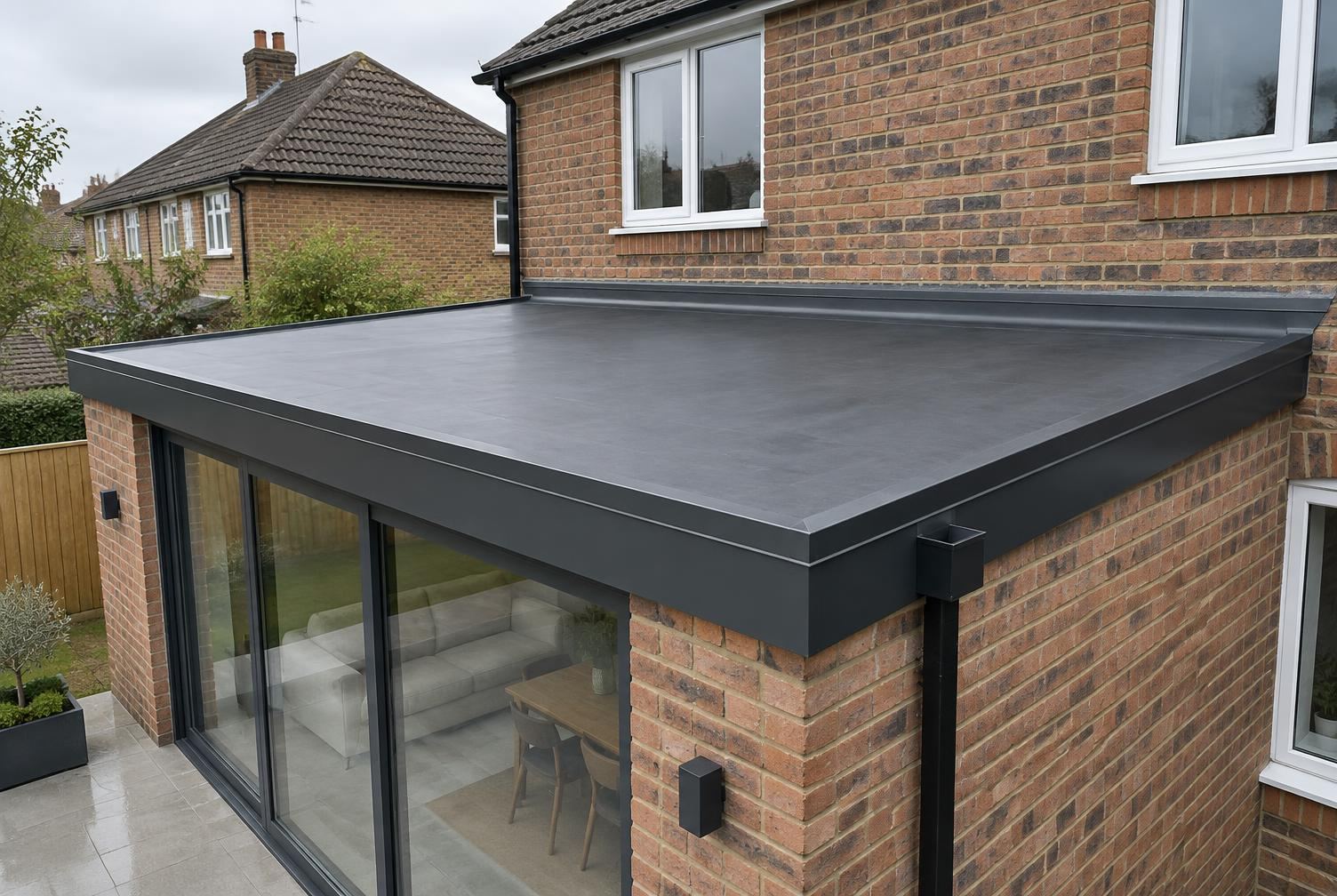
Flat roof repairs
Felt and torch-on roof repairs
Felt roofs usually tell you they're failing before they leak: blisters, cracks, bald patches and felt pulling away from the wall. We repair them with matching bitumen membrane, and where a flame would be a fire risk we use torch-free products instead.
Splits, blisters, bald patches and failed upstands repaired on modern torch-on and older built-up felt roofs.
Free photographed survey
Every slope, chimney and gutter photographed.
Report yours to keep
Whether you hire us or not.
Agreed in writing
Scope fixed before any work starts.
One point of contact
Your survey and every follow-up handled by one person, Mon–Sat, 8am–6pm.
Causes
Why felt roofs fail
Sun, cold, movement and trapped moisture wear felt out, and each leaves its own mark.
Blisters
Air or moisture trapped between the layers expands in the sun and lifts the felt. The raised pocket is weak and splits easily underfoot.
Splits and cracks
Age and cold make felt brittle, and the deck boards move at their joints. Cracks often follow those joints in straight lines.
Bald patches
Once the mineral granules wash off, the bare bitumen is exposed to the sun. It then starts to craze and crack.
Upstands and flashings
The felt pulls away from the wall, or a cement fillet at the junction cracks. Rain running down the brickwork then gets behind it.
Open laps
The overlap between two sheets lifts. Water is drawn into the gap and travels under the felt.
Standing water
A roof that holds water after rain ages faster wherever the puddle sits. Those spots are usually the first to crack.
Our method
How we repair felt and torch-on roofs
Each fault gets its own fix, always in bitumen membrane that matches the roof.
Blisters
An intact, dry blister is often best left alone and watched. A split blister is cut open, dried, bonded back down and covered with a patch.
Splits and cracks
We clean back to sound felt, then cover the damage with new membrane bonded well past it.
Upstands
We re-form them with new membrane at least 150mm up the wall, with a new flashing into the brickwork. See chimney work and leadwork.
Open laps
Lifted overlaps are re-bonded and sealed.
Bald areas
A new cap sheet goes over the existing layers, as long as they're sound and dry.
Outlets
Each outlet is cleared and re-dressed into the membrane.
Fire safety
When we don't use a torch
Wherever a flame could catch timber or reach into the roof, we switch to torch-free products.
Under the NFRC's Safe2Torch guidance, the risky parts of a job default to torch-free products, and the torch comes back only where the area is shown to be safe. On repairs, that usually means anywhere near timber fascias, cladding, open eaves, rooflights or a timber garden building.
For how we lay a whole new felt roof, see torch-on felt roofing.
Overlays
Can a new layer go over the old felt?
Only when the existing layers are sound, dry and well bonded.
IKO recommends a survey and core samples before overlaying, and Bauder says an overlay needs the existing roof to be free from water damage. Felt laid over wet layers traps the moisture, which comes back as blisters.
Covering most of the roof can also bring in Building Regulations insulation requirements, explained on our flat roofing page.
Replacement
When a felt roof needs replacing
When the faults are everywhere, or the problem is below the felt, patching stops paying off.
- Blistering or cracking across most of the roof.
- A soft deck.
- Wet insulation.
- Repairs on top of repairs.
- An old chippings roof that's failing in several places at once.
Older roofs
Older felt roofs with stone chippings
We clear the chippings back around the repair first, so the new membrane sticks to felt rather than stones.
Many older felt roofs were finished with loose stone chippings bedded in bitumen. A patch laid over them would only bond to the stones and lift.
Cost
What affects the cost of a felt roof repair?
Mainly the time spent finding the leak and how much edge work is needed.
- Finding the leak.
- The number of patches.
- Re-forming upstands and flashings.
- Clearing chippings.
- Torch-free products near timber.
- Access.
Questions
Felt roof repair questions
Is it worth repairing a blistered felt roof?
If the blisters are few and the deck is dry, yes. If they cover most of the roof, the layers have usually lost their bond and replacement is better value.
Why does my felt roof leak where it meets the wall?
Usually the upstand or flashing: the felt has pulled away, or the fillet or flashing above it has cracked. Water gets behind it and runs down inside the wall line.
Can a felt roof be repaired in cold weather?
Yes, if the surface is dry. Torch-on membranes are stiffer in the cold, but they still bond to a dry roof.
Related
Flat roof repairs
All flat roof faults, and when repair stops making sense.
Torch-on felt roofing
New layered felt roofs laid to Safe2Torch guidance.
EPDM rubber roof repairs
Repairs for rubber roofs, using rubber products only.
Chimney work and leadwork
Flashings into brickwork renewed.
Emergency roof repairs
A leak coming in now, made safe first.
Sources and further reading
- What is Safe2Torch guidance? (IKO)
- Can you overlay an existing flat roof? (IKO)
- Assessing a roof for refurbishment (Bauder)
- How to avoid defects claims on flat roofs (LABC)
Written by Hawkes Roofing, roofers based in St Albans. Last reviewed .
Free · Photographed · No pressure
Find out what your roof actually needs.
Get a quote for your roofing work. The survey is free. If we can advise from your photos, we’ll tell you; if we need to look, we photograph every part we can safely reach.