
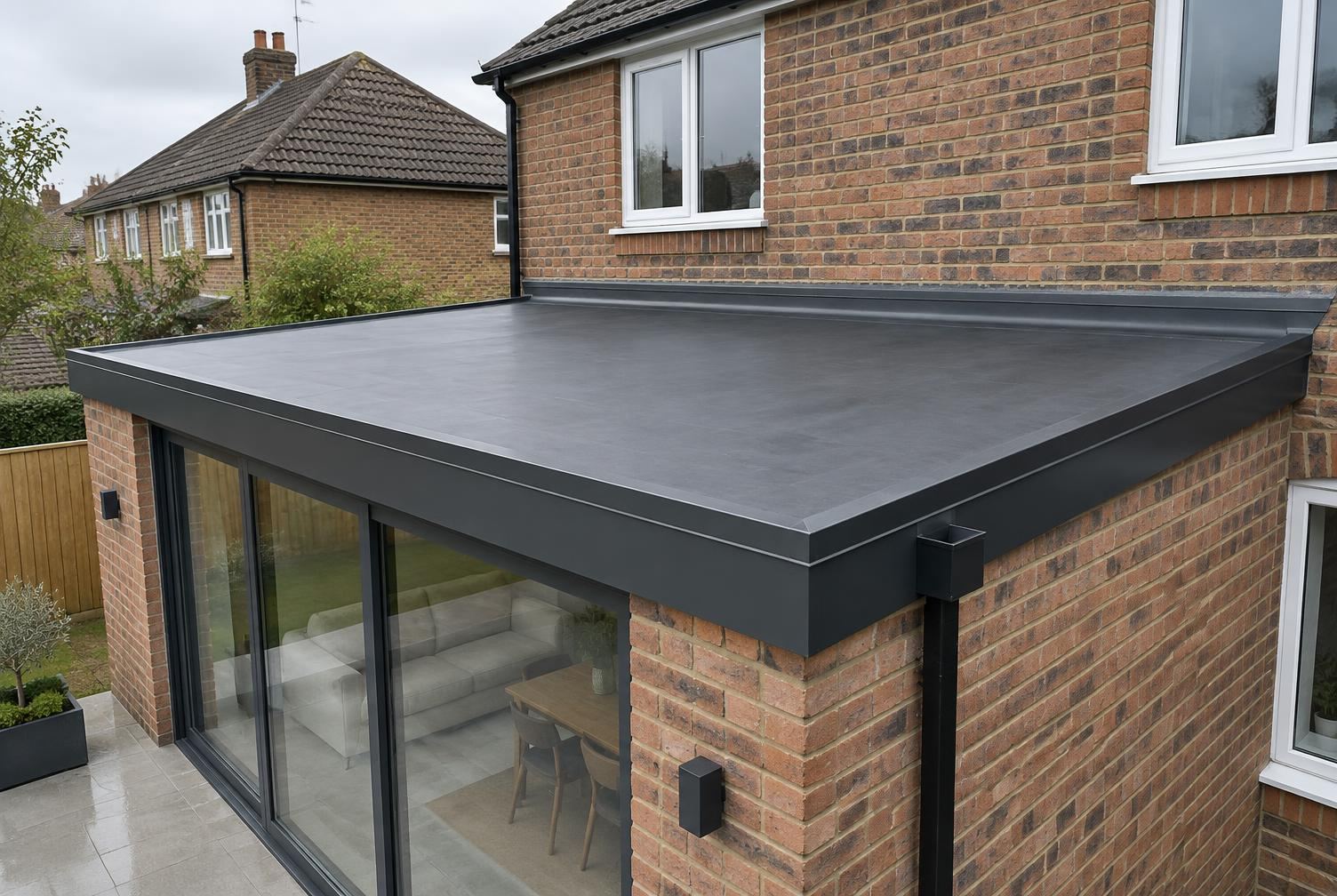
Flat roof repairs
EPDM rubber roof repairs
An EPDM roof rarely fails across the middle; leaks come from punctures, joins, edges and outlets. We repair them with EPDM primer, tape and patches, because the bitumen products many repairs reach for damage rubber.
Punctures, lifted edges, failed joins and loose trims, repaired with materials made for rubber.
Free photographed survey
Every slope, chimney and gutter photographed.
Report yours to keep
Whether you hire us or not.
Agreed in writing
Scope fixed before any work starts.
One point of contact
Your survey and every follow-up handled by one person, Mon–Sat, 8am–6pm.
Causes
Why rubber roofs leak
Almost always at a detail or a point of damage, not through the open sheet.
Punctures and tears
Falling branches, dropped tools, sharp debris or heavy foot traffic can pierce the sheet. A small hole lets water straight onto the deck, where it spreads before showing indoors.
Edges and upstands
The rubber may never have been fully bonded up the wall, or the sealant behind a wall trim has failed. Either way, rain runs down the wall and in behind the membrane.
Joins
Seam tape lifts where the surface wasn't cleaned and primed when the roof was laid. Once one end of a join opens, water works along it.
Outlets
The flashing round the outlet has failed, or the outlet is blocked and water backs up. Standing water then finds any weak point near the drain.
Pipes and flues
A detail round a pipe or flue has split, or was never sealed properly. Elevate says a hot flue needs a double-walled penetration.
Roofs laid from a kit
EPDM is sold in DIY kits. When the primer, tapes or trims are skipped, those details are where the leak starts.
Materials
Why we never use bitumen on a rubber roof
Bitumen and oil-based products attack EPDM, so they make a rubber roof worse, not better.
Elevate says contact with mineral and vegetable oils, petroleum-based products, fresh bitumen and grease must be avoided. That rules out bitumen mastic, felt paint and roofing cement.
If an earlier repair used any of them, we cut back to clean rubber before patching.
Our method
How we repair EPDM
We clean, prime and patch with rubber products, then put right any edges that have let go.
- 01
Find and photograph the fault
We locate the actual point of entry and photograph it for your report before touching anything.
- 02
Clean and dry the area
Dirt, moss and moisture stop primer and tape from gripping, so the rubber round the fault is cleaned and dried first.
- 03
Prime
We use the maker's EPDM primer. Elevate says its QuickPrime Plus must be used with all its QuickSeam products.
- 04
Patch
Self-adhesive EPDM flashing or cover tape runs well past the damage, with rounded corners so the edges don't lift, and is rolled down firmly.
- 05
Edges
Lifted upstands are re-bonded, loose trims are re-fixed and re-sealed, and outlets are re-flashed.
- 06
Replace a section
When the damage is too big to patch, we cut out that part of the membrane and replace it.
Replacement
When a rubber roof needs replacing, not repairing
When the problem is underneath the rubber or spread across the whole roof, patches won't hold.
- The deck under the membrane is soft or wet.
- Large areas have come unbonded.
- Many joins are failing at once.
- The roof was laid with no fall, so water stands everywhere.
- The deck is old chipboard.
Our flat roofing page explains how a replacement is done.
Bubbles
Bubbles under a rubber roof
A bubble usually means the membrane has lost its bond there, with air or moisture trapped underneath.
A dry bubble isn't always a leak. We check whether the deck beneath it is wet before deciding whether to re-bond, patch or replace.
Weather
When EPDM can be repaired
On a dry day that's mild enough for the adhesive, because primer and tape only grip clean, dry rubber.
The adhesives also have minimum temperatures. If it's raining when you call, we make the roof safe straight away and return to fit the permanent patch once the membrane has dried.
Cost
What affects the cost of an EPDM repair?
How hard the leak is to find and how many places need work.
- Finding the leak.
- How many places need patching.
- Whether upstands or trims need re-forming.
- Access.
- Whether earlier bitumen repairs need cutting out.
- Whether the deck is wet.
Questions
EPDM repair questions
Can I fix a rubber roof with a DIY patch kit?
A small puncture can be patched with an EPDM kit if the area is cleaned and primed first. Leaks at upstands, trims and outlets are harder to get right, and a failed DIY patch makes the next repair bigger.
Can you repair a rubber roof someone else laid?
Yes. We use EPDM primers and tapes. If the roof is still under a maker's warranty, check its terms first: ClassicBond's guide tells owners to contact the system maker to confirm compatible products and warranty terms before a repair.
Can a rubber roof be coated instead of patched?
Only with a coating made for EPDM. On a sound rubber roof, a proper patch is usually the better repair.
Related
Flat roof repairs
Every type of flat roof fault, and how we decide between repair and replacement.
EPDM rubber roofing
New rubber roofs, for when patching is no longer worth it.
Felt and torch-on roof repairs
Repairs for bitumen felt roofs.
Emergency roof repairs
Water coming in now? We make it safe first.
Gutter cleaning
Outlets and gutters cleared so water drains away.
Sources and further reading
Written by Hawkes Roofing, roofers based in St Albans. Last reviewed .
Free · Photographed · No pressure
Find out what your roof actually needs.
Get a quote for your roofing work. The survey is free. If we can advise from your photos, we’ll tell you; if we need to look, we photograph every part we can safely reach.